How Colson of York is Making Their Own Analogue Amps

Colson of York painstakingly create handmade, analogue guitar amps out of locally-sourced materials


Drew's path to craft was a winding one, and his background has included everything from a degree in organic chemistry and working in pharmaceuticals to time spent as a freelance marketer and copywriter. Throughout it all, Drew has had a keen love of music. This passion, and his love for creating things, led to Colson of York and his bespoke, analogue guitar amps.
‘What probably started me on this journey was I began making chairs about eight years ago,’ he explains. ‘That kickstarted the whole cabinetry side of this.’ During house renovations a number of years ago, Drew acquired quality planks of locally-felled sycamore which he knew would be perfect for a project – but what to build?
‘I’ve always played guitar and I gig professionally in bands,’ explains Drew. ‘As guitarists, we’re all chasing that right guitar sound. It’s more about how it feels under your fingertips.’ Analogue amps, Drew says, feel completely different to modern alternatives. ‘With a fully analogue amplifier, it breathes. You touch the strings and you get harmonics and if you hit them harder it sounds different. You can’t really get that with a modern day amplifier,’ he explains. ‘What a modern day amplifier does is you plug your guitar into it, and when you play the guitar it converts that electrical signal into digital data and then the software processes it and it changes back to sound waves.’
Drew knew he had the skills and materials necessary to make excellent analogue amplifiers. ‘With an analogue amplifier, it stays as an electrical circuit. It goes and moves through resistors and diodes, getting shaped as an organic sound. It sounds a bit daft but you can hear the difference. I started building my amplifiers about three years ago.’
Drew wanted to provide an analogue alternative in an increasingly digital world. ‘I quite like the idea of building something organic, which is where these amps came in. I’ve been trying to search for this sound myself.’ Drew began slowly, building two amps, and has since built a range of three ‘sister’ amplifiers from the same piece of Yorkshire sycamore, launching Colson of York in the process.
When it comes to his materials, Drew emphasises the importance of sourcing them as locally as possible whilst retaining a high quality. The wood in particular was a local find. ‘I bought some sycamore from a place up near Harrogate and Ripon. It was all wood felled from a field,’ says Drew. ‘The plank of sycamore that I had was enough to make three amplifiers. I felt that they were all related because of that. I felt that they were sisters that shared the same DNA, and it’s pretty cool because when I put them side by side you’ve got that continuing journey in the grain.’
Each of his amps has a distinctive character and unique markings which occur during a natural process. ‘There’s something called spalting you can do with wood whereby you encourage bacteria to grow on it and actually change the grain of the wood itself,’ he says. ‘When you start cutting into the wood it’s got all these really cool ripples and colours through it.’
The amps aren’t solely sycamore, and Drew also sourced sapele nearby. ‘The sapele, which is like a mahogany, I bought relatively recently from a hardwood supplier in York who has been there since the '70s – it’s an old traditional wood shop. It just makes sense to me that I want to be using things that are local to the environment, so I’ll be doing that as much as possible.’
Drew admits that some items are harder to source in Yorkshire, but even so, he does his best to find English-made options. ‘Speakers makes a difference to the sound because the way they’re manufactured can change the tone, and also where they’re manufactured. There’s a company called Celestion which is one of the revered speaker companies for musicians,’ says Drew, explaining that the company moved their manufacturing abroad in the early 2000s. ‘I’ve actually been able to find some speakers that were made in 1998. So these are 27-year old speakers which were actually manufactured in England which again just feels right.’

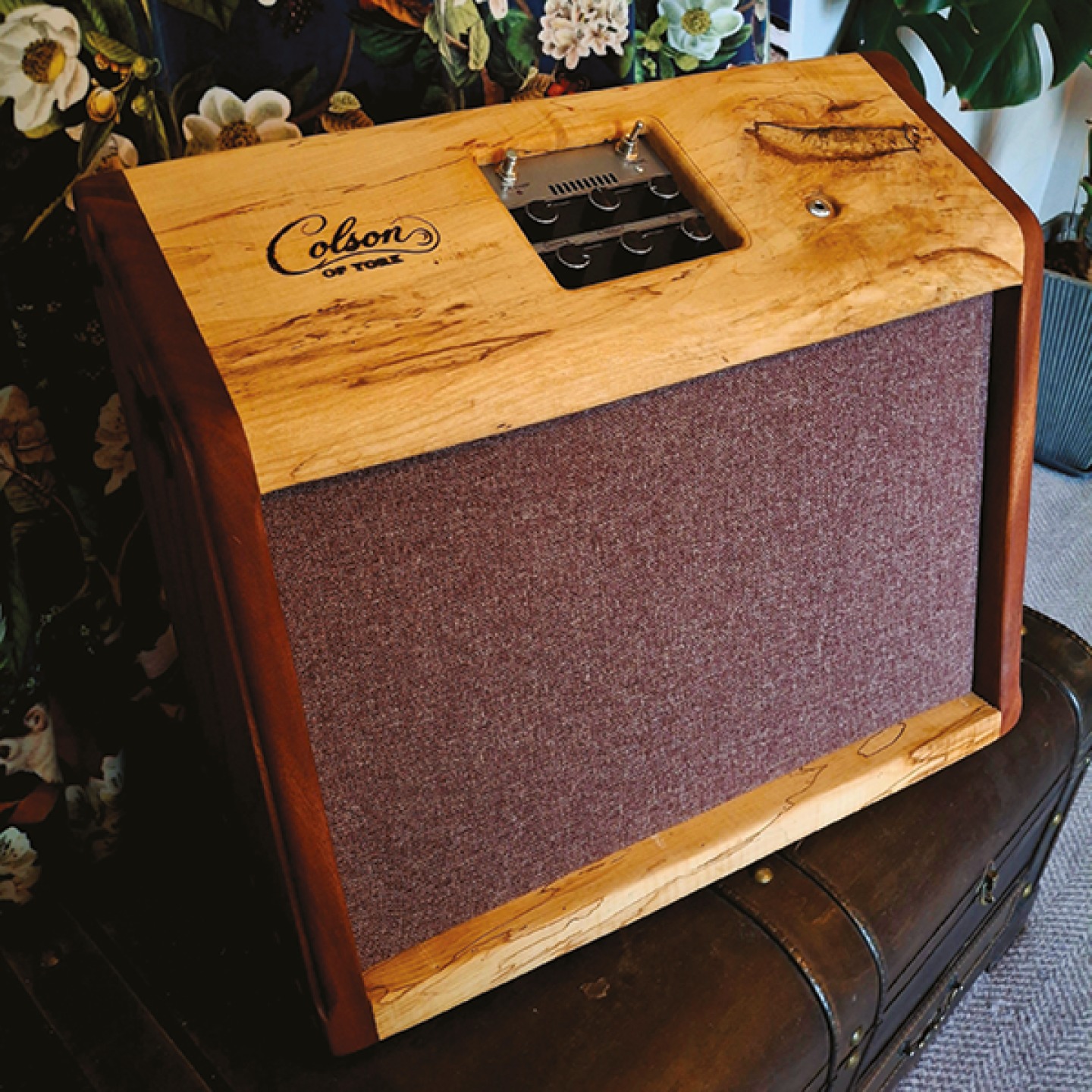
Drew’s insights as a musician have also allowed him to introduce unique elements to the designs of his ‘Three Sisters of Ainsby’. He explains that mass produced amplifiers tend to be box-like, and so to get the best projection from them musicians often lean them backwards against a wall. Drew made this a design feature of his amps. ‘You’ll see from the pictures that the speaker is just naturally tilted upwards so the sound fills the room more.’ Similarly, Drew knows all too well how often drinks are balanced on top of amps, and has worked to prevent spills on his amps, which are not covered in the standard plastic coating. ‘I’ve intentionally made the top slope as well so that you can’t put a drink on it!’
When we speak, Drew’s work on his first collection of three has just ended and he already has interested potential buyers, but he wants to make sure the amps are appreciated in their new homes. ‘These are my first three and I want them to be used, and to be looked after,’ he says. ‘I only just finished building them, so this is really new. It sounds a bit daft, but they’re kind of my children.’