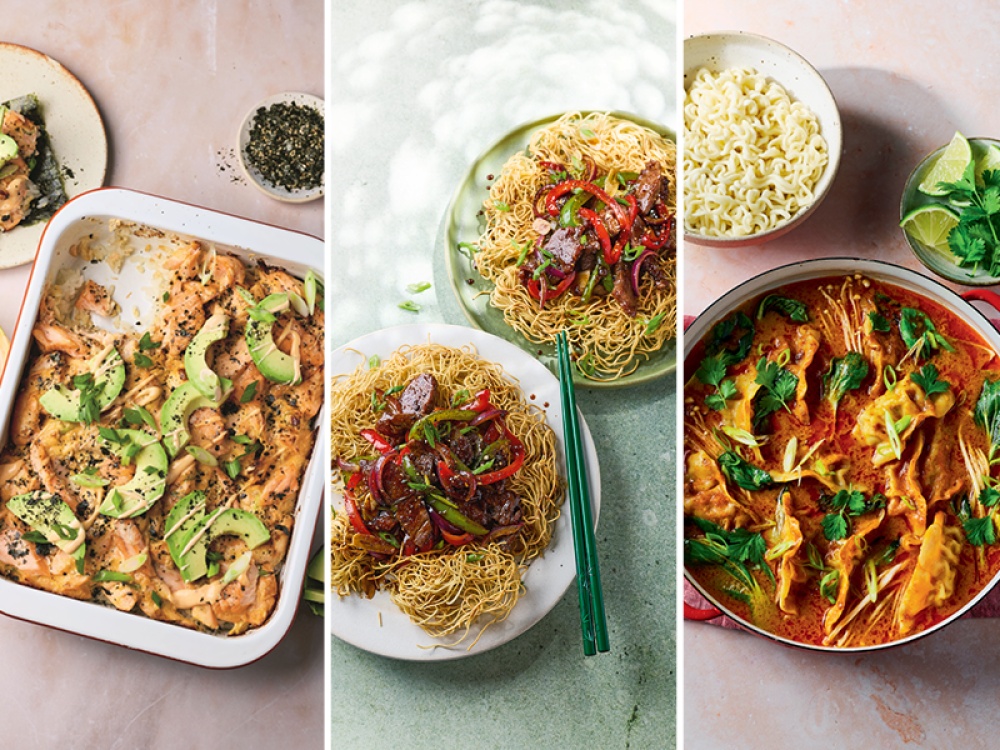
Three Must-Make Recipes from Eva Pau's New Cookbook
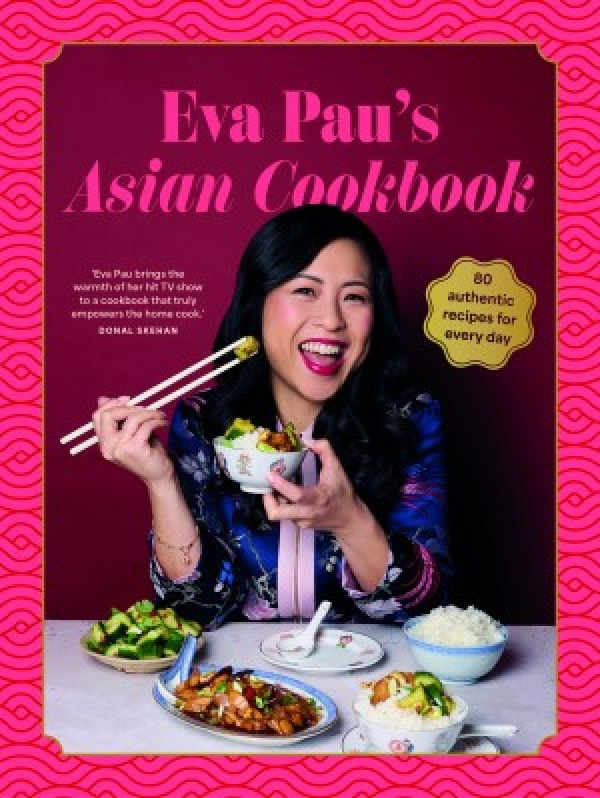
Eva Pau's Asian Cookbook contains 80 authentic recipes for every day
For TV food personality Eva Pau, Asian cooking has always been an integral part of her life. Growing up in Dublin, learning to cook with her Hong Kong-born mother, and spending time in her parents' small Asian grocery, Eva discovered the incredible richness and variety of Asian food culture. In her new book, Eva shares over 80 delicious recipes, featuring dishes from China, Japan, Korea, Vietnam, Thailand, Malaysia and Singapore, plus all her tips and tricks.


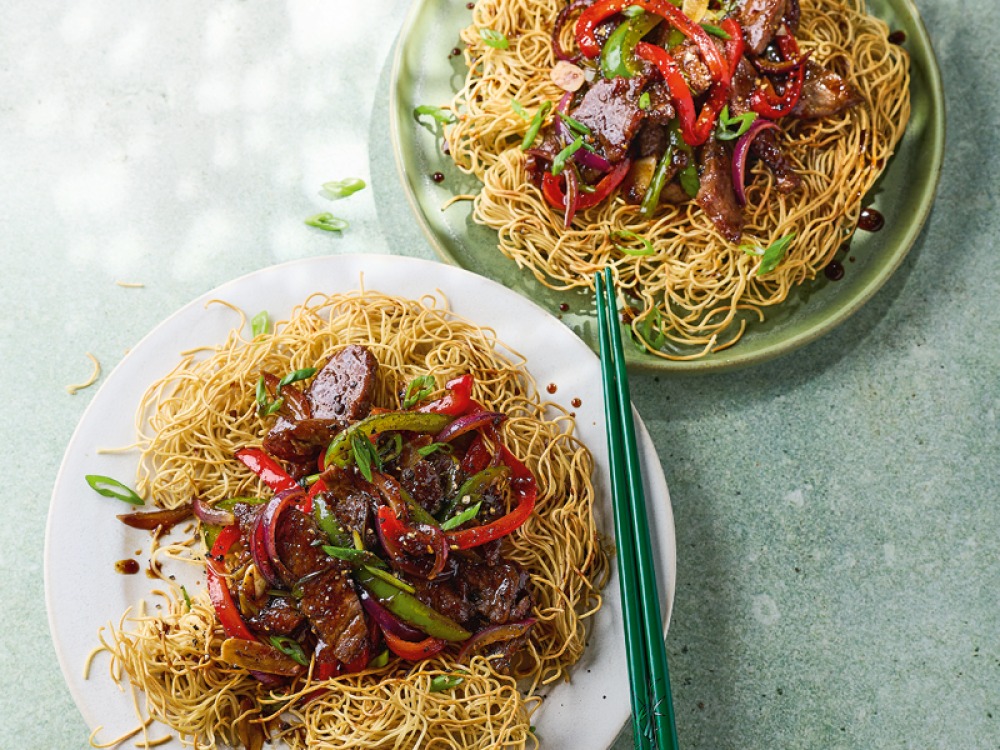
Black Pepper Beef with Crispy Noodle Pancake
Black pepper beef is a go-to Chinese restaurant dish: tender strips of beef stir-fried in a light sauce with a fiery black pepper punch. Coarsely ground black pepper is the key ingredient here, but for me the real star of the dish is the crispy golden noodle pancake served under the beef stir-fry. What I love most is how the noodles stay so crispy on the outside while softening slightly underneath where the sauce hits. This pancake looks impressive, but it’s actually pretty simple to make at home.
Serves
2
Prep time:
15 minutes
Cooking time:
15 minutes
Ingredients
- 220g sirloin steak, thinly sliced
- 95g dried thin egg noodles
- 2 tbsp neutral oil
- 1 red onion, thinly sliced
- 2 garlic cloves, thinly sliced
- ½ red pepper, thinly sliced
- ½ green pepper, thinly sliced
- 2 spring onions, cut in 2cm lengths and julienned, plus extra, finely sliced, to garnish
- For the marinade
- 1 tbsp light soy sauce
- ½ tbsp Shaoxing wine
- 1 tsp granulated sugar
- 1 tbsp cornstarch
- ½ tsp baking soda
- ¼ tsp ground white pepper
- For the sauce
- 1 tbsp light soy sauce
- 1 tbsp oyster sauce
- 1 tbsp Shaoxing wine
- 1 tbsp dark soy sauce
- ½ tbsp white rice vinegar
- 2 tsp granulated sugar
- 1 tsp coarsely ground black pepper
Method
Combine all the marinade ingredients in a bowl. Add the sliced beef and stir to coat. Set aside.
In a separate bowl, mix together all the sauce ingredients and set aside.
Place the egg noodles in a large bowl and pour over enough just-boiled water to submerge. Cover the bowl with a plate and leave for two minutes, then drain. Place the noodles on a tray lined with paper towels or a dry tea towel so that they can dry out slightly.
Heat one tablespoon of the oil in a 20cm frying pan over a medium heat. Add the noodles to the pan and spread them out to fill the pan like a thin pancake. Fry for three to four minutes on each side or until golden brown. Place on a plate and set aside.
Place a non-stick wok over a medium–high heat. Add the remaining one tablespoon of oil and heat until shimmering. Add the red onion and stir-fry for 20 seconds, then add the garlic and the marinated beef and stir-fry for a further three minutes.
Add the red and green peppers and stir-fry for a further three to four minutes, then add the spring onions and sauce mix. Stir-fry for a couple of minutes until slightly thickened, then spoon the black pepper beef over the middle of the crispy noodle pancake and garnish with finely sliced spring onions to serve.
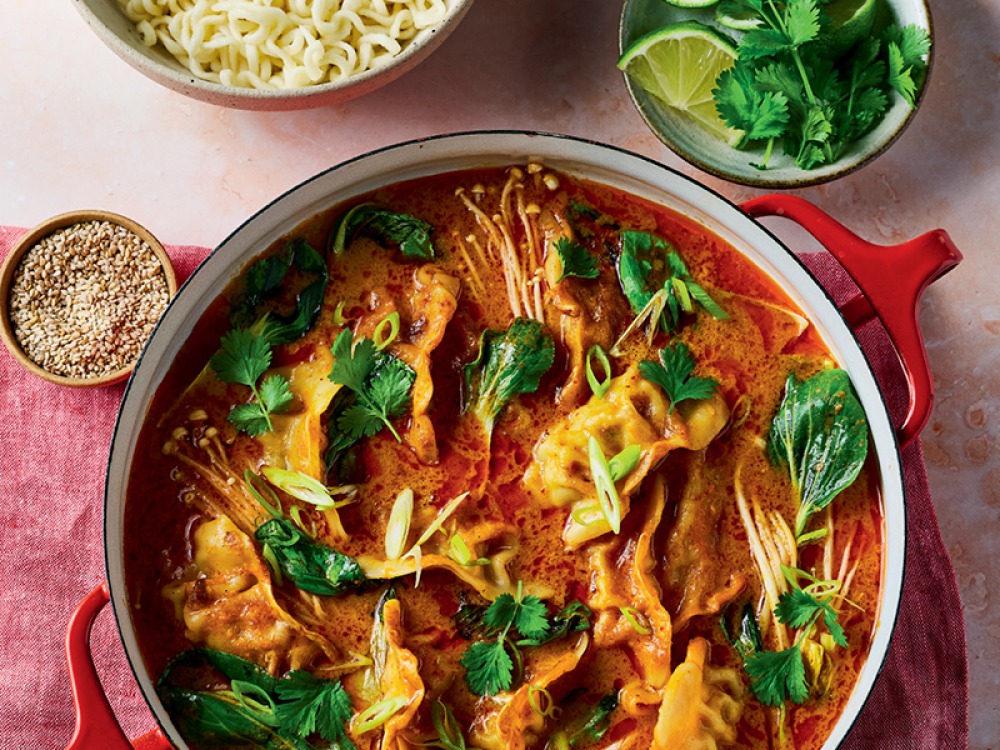
One-pot Thai Red Curry Dumplings
This is such a simple dish to whip up, and a great way to elevate the humble dumpling. It’s a bit like a pasta bake, but with dumplings. You start by making a Thai red curry sauce in a baking tray, then adding your dumplings and veg and letting it bake away in the oven while you relax and help the kids with their homework! You can enjoy this straight from the baking tray or make it go even further by serving it on a bed of noodles in a bowl. This is serious comfort food.
Serves
4
Prep time:
10 minutes
Cooking time:
30 minutes
Ingredients
- 2–3 heads of baby pak choi, halved or quartered
- 100g enoki mushrooms
- 16 dumplings, frozen or fresh
- For the sauce
- 2 garlic cloves, minced
- 1 tsp freshly grated ginger
- 2 tbsp light soy sauce
- 2 tbsp Thai red curry paste
- 1 tsp toasted sesame oil
- 1 tbsp white rice vinegar
- 350ml chicken or vegetable stock
- 400g tin coconut milk
- To serve
- 2 spring onions, thinly sliced
- handful of coriander leaves, roughly chopped
- 1–2 tsp crispy chilli oil
- 1 tsp toasted white sesame seeds
- 1 lime, cut into wedges
- Cooked ramen noodles
Method
Preheat the oven to 180C fan.
In a large baking dish, combine all the sauce ingredients and stir until smooth and well blended.
Nestle the halved pak choi and trimmed enoki mushrooms into the sauce, then place the dumplings on top, arranging them evenly across the dish. Bake for 30 minutes, or until the dumplings are tender and fully cooked through.
Top with the sliced spring onions, coriander leaves, a drizzle of chilli oil and a sprinkling of toasted sesame seeds. Serve warm, ladled into small bowls, with lime wedges for squeezing and ramen noodles.
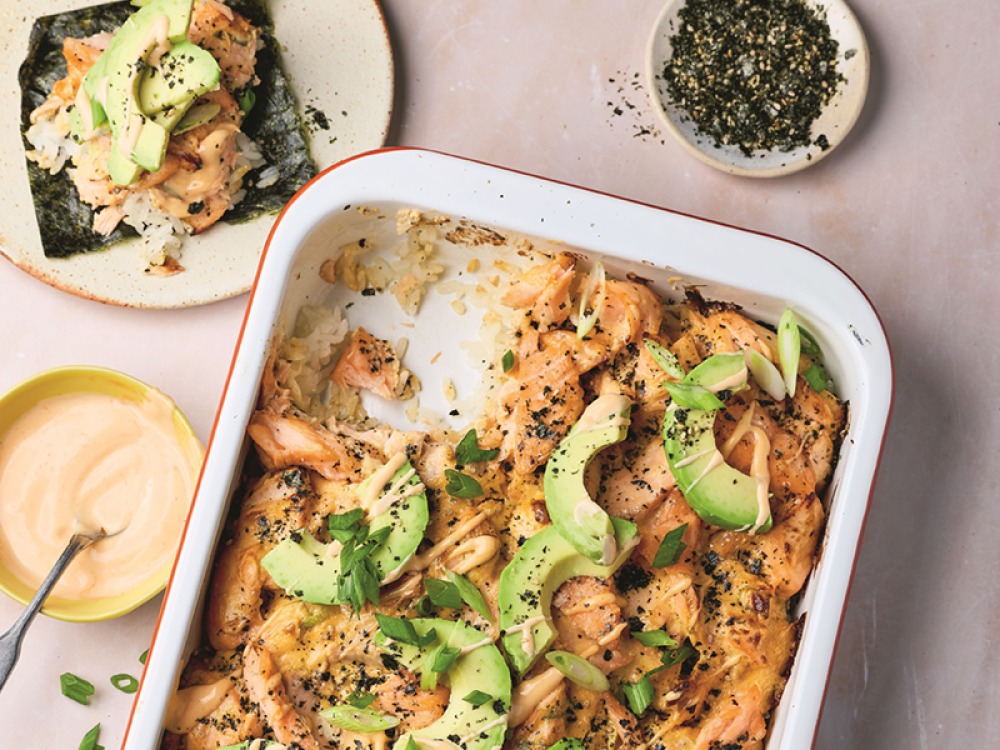
Salmon Sushi Bake
A sushi bake consists of a layer of sushi rice with a topping, baked in the oven. To eat it, all you do is grab a small piece of nori seaweed, scoop up some of the sushi bake on to it and enjoy. No rolling, no cutting, no hassle – just the lovely flavours of sushi! The first time I tried a sushi bake was when a friend from the Philippines made it for me. She told me they make this dish a lot as it's perfect for gatherings. I’ve included instructions for a very simple furikake, which you can buy ready-made in many different flavours if you prefer.
Serves
4
Prep time:
15 minutes
Cooking time:
30 minutes
Ingredients
- 300g sushi rice
- 400g skinless salmon fillets
- ¾ tsp salt
- 2 tbsp Japanese rice vinegar
- 1 tbsp caster sugar
- 100g Japanese mayonnaise (see below)
- 50g cream cheese
- 2 tbsp sriracha
- 1 tbsp Japanese soy sauce
- 1 tsp sesame oil
- 2 spring onions, finely sliced
- For the furikake
- 1 nori sheet, cut into 3cm squares
- ½ tbsp sesame seeds, toasted
- For the sriracha mayonnaise
- 5 tbsp Japanese mayonnaise
- 2 tbsp sriracha
- To serve
- 1 avocado, peeled, stoned and finely sliced
- 8–10 nori sheets, each cut into 6 squares
Method
Preheat the oven to 180C fan.
Rinse the sushi rice under cold water until the water runs clear. Tip the rinsed rice into a saucepan and add 375ml water. Bring to the boil, then reduce the heat to low and cover with a lid. Simmer for 15 minutes, then remove from the heat and leave to sit, still covered, for 10 minutes. Alternatively, use a rice cooker.
Meanwhile, season the salmon with half a teaspoon of the salt, then air-fry at 180C for 8–10 minutes until cooked through. Once cooked, remove to a plate and leave to cool before flaking into large pieces. Alternatively, cook in an oven preheated to 180C fan for 10 minutes.
To make the furikake, place a small frying pan over a medium heat. Add the nori and sesame seeds, and dry-fry for two minutes until the seaweed pieces are crispy. Tip into a bowl and crush the nori into little pieces, then set aside. If you prefer, you can blitz it in a spice grinder.
In a small bowl, combine the rice vinegar, sugar and remaining quarter teaspoon of salt, and stir until the sugar and salt dissolve. Stir this mixture into the warm rice.
In another bowl, combine the mayonnaise, cream cheese, sriracha, soy sauce and sesame oil. Stir until smooth, then add the cooked, flaked salmon and half the sliced spring onions and stir.
To assemble, tip the seasoned sushi rice into a 20 × 25cm baking dish and spread out into an even layer. Sprinkle half of the furikake over the top, then add the salmon mixture and spread it out into an even layer over the rice. Sprinkle the remaining furikake over the top, then bake for 15 minutes, or until the top is slightly golden and bubbling.
Meanwhile, combine the sriracha mayonnaise ingredients and set aside.
Remove the sushi bake from the oven and drizzle with the sriracha mayonnaise, then garnish with the avocado and remaining spring onions. Slice into squares and serve warm, with the nori sheets for scooping.
Japanese mayonnaise
Japanese mayonnaise has really taken Europe by storm – and for good reason. It is richer, tangier, creamier and more flavourful than regular mayo. It’s made with rice vinegar and egg yolks, which gives it that distinctive flavour. Once you try it, you won’t want to go back. If you are making sushi, you really need to have this. The most common brand is Kewpie.